
Identify the post and follow its evidence
AMA Social Media Citation for Specific Public Posts
Use a public WHO post to identify the original account, preserve a specific permalink, and distinguish the post from a repost or linked publication.
An AMA social media citation should take a reader to the specific public post you used. Start by deciding what your sentence needs to establish. Are you discussing an institution’s public wording, or a finding mentioned in its feed? We checked TCU’s AMA teaching guide and a June 27, 2025, WHO Bluesky post against the WHO pages it links to. The post, its linked news release, and the report behind that release each need to be identified separately.
Decide whether the post itself is your source
A post can be the right source when you analyze an announcement, quote an organization’s wording, or examine how it communicates with the public. Your sentence should make that purpose clear. A post describing a study gives you a route to the study, whose methods and findings need their own reading.
TCU’s AMA guide, on printed page 39, presents social media examples and cautions that casually presented information may fall short of scientific standards. Its Twitter example includes the account handle and post wording, followed by the posting date, access date, and a specific status URL. This is a useful teaching model for an AMA tweet citation. Applying it to another platform requires checking your journal or course instructions.
Identify the original account and specific post
The public example here is a WHO post from the account @who.int on Bluesky, dated June 27, 2025. Its permalink ends in 3lslxjnwgbk26. It belongs to a thread, so opening the account’s profile or citing the thread’s first message would identify a different object. Select the message whose wording you actually discuss.
Record the displayed account name and handle together. Check the full post before copying its date or content, since search snippets and feed previews can omit the surrounding thread. A familiar institution name alone does not identify a particular message. Keep the post URL in your notes even if you first encountered it through somebody else’s feed.
Separate the original, a repost, and the linked article
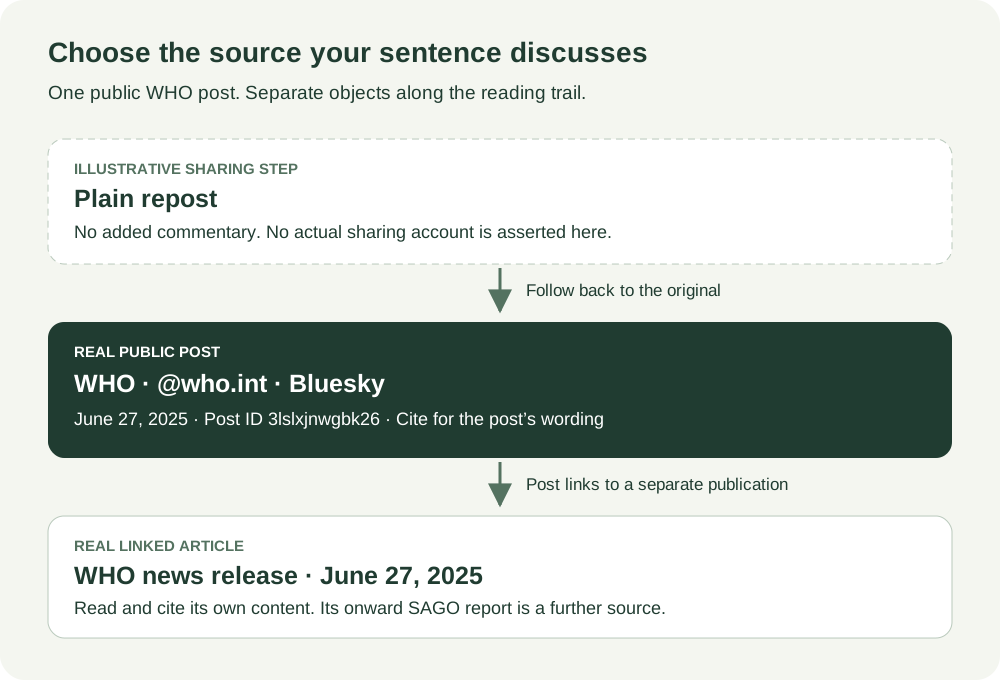
The WHO post contains a shortened link with a preview for a WHO news release dated June 27, 2025. The destination labels itself a news release and links onward to a SAGO report. Those pages have separate titles and publication records. The social post cannot stand in for a report you have not read.
The diagram uses that real post and its linked news release. The plain repost is illustrative; no second account’s sharing activity is asserted. If another account simply redistributes the post, follow it back to WHO when WHO’s wording is your subject. If a quote post adds commentary you analyze, preserve that separate post and credit its own author.
Build the reference from the record you checked
The following working example adapts the fields in TCU’s Twitter example to Bluesky and adds the organization’s name and platform for clarity. The opening sentence identifies the post here; it is an excerpt, with the rest omitted. Check your destination’s requirements for reproducing post text before submitting. Treat it as an adaptation for review with your instructor or editor; the TCU guide does not give a Bluesky template.
Adapted public-post reference using an identifying excerpt
World Health Organization (@who.int). Therefore, the work to understand the origins of SARS-CoV-2 remains unfinished. Bluesky. June 27, 2025. Accessed November 1, 2026. https://bsky.app/profile/who.int/post/3lslxjnwgbk26
The opening sentence is quoted only to identify this specific post. The access date records this guide’s check; use your own actual access date.
Preserve dates and a retrievable link
Keep the posting date separate from the day you accessed the post. Neither date should be borrowed from the linked article. A repost can appear much later than the original message. When a platform displays a relative time, open the individual post to look for a full date and record any timezone needed for a timing-sensitive analysis.
Use the post’s permalink in its reference. The shortened link inside the WHO message leads to the news release, so using that link would send the reader away from the cited post. For an AMA Instagram citation, apply the same identification checks to the particular public post and its caption. The TCU page used here supplies no Instagram-specific template; check the destination’s guidance for exact formatting.
Check edited, reposted, or unavailable content
Reopen the permalink before submitting and compare the wording with your notes. If an edit changes the passage you discuss, identify the version you actually consulted and explain a material difference. Preserve an appropriate working record where permitted. A screenshot can help document your reading, but it may omit the date, account identity, or link needed to retrieve the source.
The WHO report landing page now notes that its download is an updated version of the original June 27 report. Even with the same publication date, a linked document can change after a social post appears. Check the current report’s version information if you use it, and document the version you read.
If the post disappears or becomes restricted, describe the access problem honestly. Do not present an unverified screenshot or another account’s paraphrase as a directly consulted original. Check whether an accessible archive or a different source supports your sentence, and follow your journal’s directions for citing it.
Finish from verified source details
If you are deciding how to cite a social media post in AMA, keep the source details beside you while you format it. Our generator has no dedicated social media form and does not reliably extract account identities or posting dates. Use your checked notes to assemble this reference manually. For supported source types, you can prepare other references in the builder, then review the combined list against your destination’s instructions.