
Give readers a usable route to each source
AMA References on Slides and Posters in Limited Space
Place readable citation markers beside the material they support, retain complete records, and distinguish local short forms from verified AMA guidance.
A superscript takes very little room on a slide. Its matching reference can take several lines. AMA short form references offer a way to handle that space problem, provided readers can still identify the source. We checked the AMA Manual’s public update notice and PATH’s writing guide on October 30, 2026. The two original layouts below keep one real paper traceable through a slide deck and a poster, with institutional advice identified where it applies.
Separate citing a poster from adding references to one
Here you are designing your own presentation and crediting the material it uses. You might need a reference beside a borrowed diagram or a marker after a statement drawn from an article. The source remains that article, regardless of whether your presentation will appear on a screen or a conference board.
Citing somebody else’s poster raises a different question. That entry identifies the poster’s authors and meeting details. A downloaded lecture deck likewise needs its own document credits. Keep those records separate from the papers you cite inside the presentation you are preparing.
Review the 2026 guidance and local requirements
OUP’s public notice dates the addition of section 3.18, Short-Form References, to May 25, 2026. It identifies posters and slide presentations as formats the section addresses. The notice does not reproduce the detailed rules. We could verify the announcement, but could not verify the complete section for this article, so the designs here make no claim to reproduce its official short-form templates.
PATH supplies a publicly readable institutional alternative. Its guide permits shortened references when a full entry will not fit a constrained format. Its examples progressively shorten the author list, abbreviate the journal, then omit the article title; a further version omits authors too while retaining publication details and the DOI. Those are PATH’s published practices. PATH also directs writers publishing through another organization to follow that organization’s requirements.
For an abbreviated AMA citation, ask which guidance your instructor or event accepts before removing fields. A required reference panel may settle the choice. If the organizer specifies a font size or a separate reference handout, build around that requirement rather than reducing everything until the text fits.
Keep one complete reference before making layout choices
The example record is John P. A. Ioannidis’s 2005 essay in PLOS Medicine. The publisher identifies volume 2, issue 8, article e124, and DOI 10.1371/journal.pmed.0020124. The NLM Catalog supplies the journal abbreviation PLoS Med. The full entry below keeps those details and uses sentence case for the title.
This is a source-identification exercise. The sample presentation says that it discusses the essay; it does not turn the essay’s title into a factual claim about every research field. Keeping that distinction visible prevents a convenient citation example from implying a conclusion the presentation has not argued.
Complete journal reference used in both layouts
1. Ioannidis JPA. Why most published research findings are false. PLoS Med. 2005;2(8):e124. doi:10.1371/journal.pmed.0020124
Institutional shortening pattern adapted from PATH
1. Ioannidis JPA. PLoS Med. 2005;2(8):e124. doi:10.1371/journal.pmed.0020124
This adaptation follows PATH’s illustrated title-omission approach. It is not presented as a verified template from AMA section 3.18.
Plan readable AMA citations on PowerPoint slides
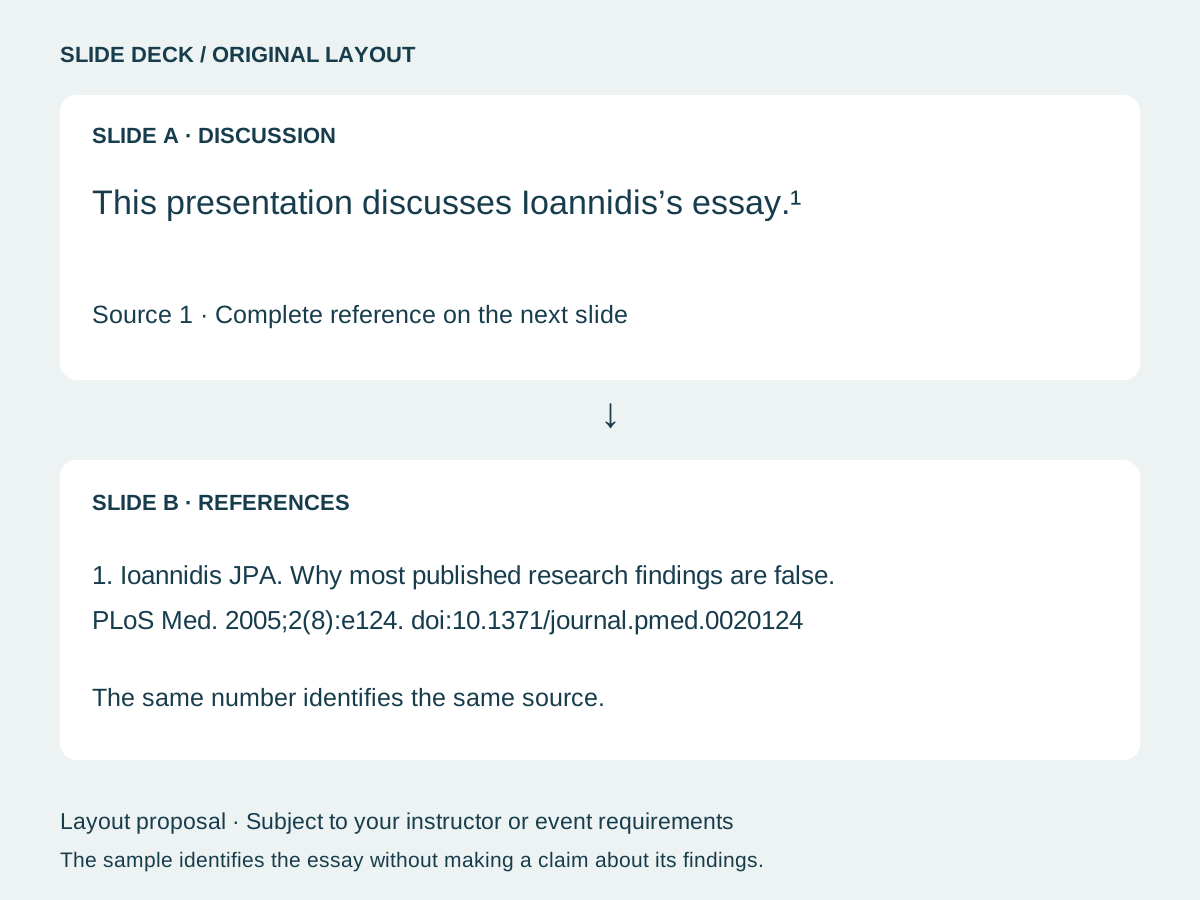
Our slide layout uses a superscript 1 beside the sentence introducing the essay. A footer directs the audience to reference 1 on the next slide, where the complete entry appears. JAMA’s public author instructions support superscript numerals and first-appearance numbering for manuscript citations. The placement and two-slide arrangement shown here are our design choices, subject to your presentation requirements.
A short deck may have room for the complete entry on the same slide. A longer deck may need several reference slides. Either way, preserve the connection between the visible marker and the correct entry. Repeated references to the same paper should point to its existing record. Avoid giving it a new identity simply because the discussion continues on another slide.
Export the PowerPoint file before checking its references. A hyperlink that works in editing mode may be awkward in a projected talk, and an audience photograph captures only one slide. Include a readable reference direction with the marker. When circulating the deck, keep the reference slides in the shared file.
Arrange AMA poster references without hiding the source
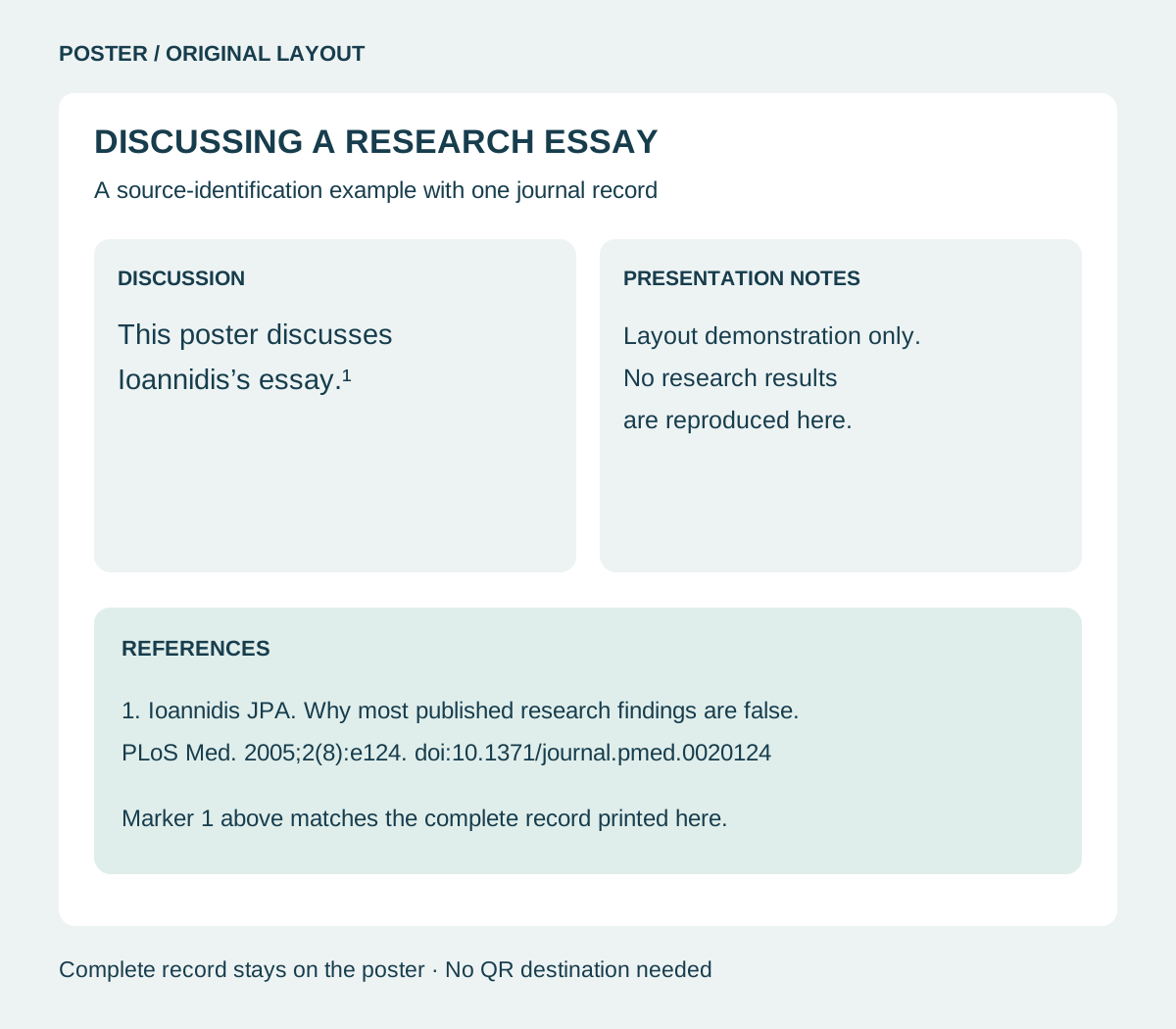
The poster layout keeps the same marker next to its discussion text and puts the complete record in a dedicated reference panel. There is only one source in this demonstration, so the panel can show it comfortably. For your actual poster, reserve reference space while drafting the content and check every marker after rearranging the columns.
If an accepted short form saves space, retain a complete record in the companion material required or permitted by your event. A QR code can supplement a visible link or handout direction. Test the printed code on another device and confirm that the destination opens without your own account. The diagram deliberately shows a complete reference panel instead of inventing a working QR destination.
Test whether a reader can locate every source
Open the final PDF and follow each marker to its reference. For this example, search the DOI and check that it resolves to Ioannidis’s essay with article number e124. Compare the author and year as well. A functioning link to a different paper still needs correction.
Check the exported file at its intended viewing size and review a print sample for a poster. Keep the reference text selectable when the export allows it. If readers will receive only a screenshot or one extracted slide, add enough source information there for that version to remain usable.
For a second check, give the export to someone who did not build it. Ask them to locate the essay from the discussion slide, then from the poster panel. Record where they hesitate. If the reference direction disappears in an extracted image, revise that version before distributing it. This is a proposed review exercise, not a claim that these layouts have been tested with an audience.
Keep teaching-file credits separate
If your source is a lecturer’s slide file, check its public access and credited authors before preparing the entry. The lecture guide covers that separate task, including how to locate a passage within a deck.